
In beta. The logic is stable and running live in the members’ channel, but the settings are still being tuned. Expect defaults to change.
Overview
Three reversal patterns in one script. They share a single idea: a level broke, the break failed, and the people who took it are now on the wrong side.
That’s the whole thesis. Yesterday’s high and low are the most-watched intraday levels there are — when price pushes through one and then closes back inside, the move that just happened wasn’t a breakout, it was a trap. This script watches for the three ways that trap tends to spring, and tags the bar it happens on.
| Module | The failed break it looks for |
|---|---|
| RDR — Red Dog Reversal | Price breaks yesterday’s high or low during the session, then closes back through it |
| Oops — Oops Reversal | The market opens beyond yesterday’s range, then crosses back in early |
| UNR — Undercut & Reclaim | Price undercuts a pivot and a moving average, then reclaims both |
All three run at once by default. You can switch any of them off.
RDR — the intraday failed break
The simplest of the three, and the one that fires most often.
Price trades through yesterday’s high or low during regular hours. It doesn’t hold. It closes back through the level. The breakout is dead and the reversal is the trade.
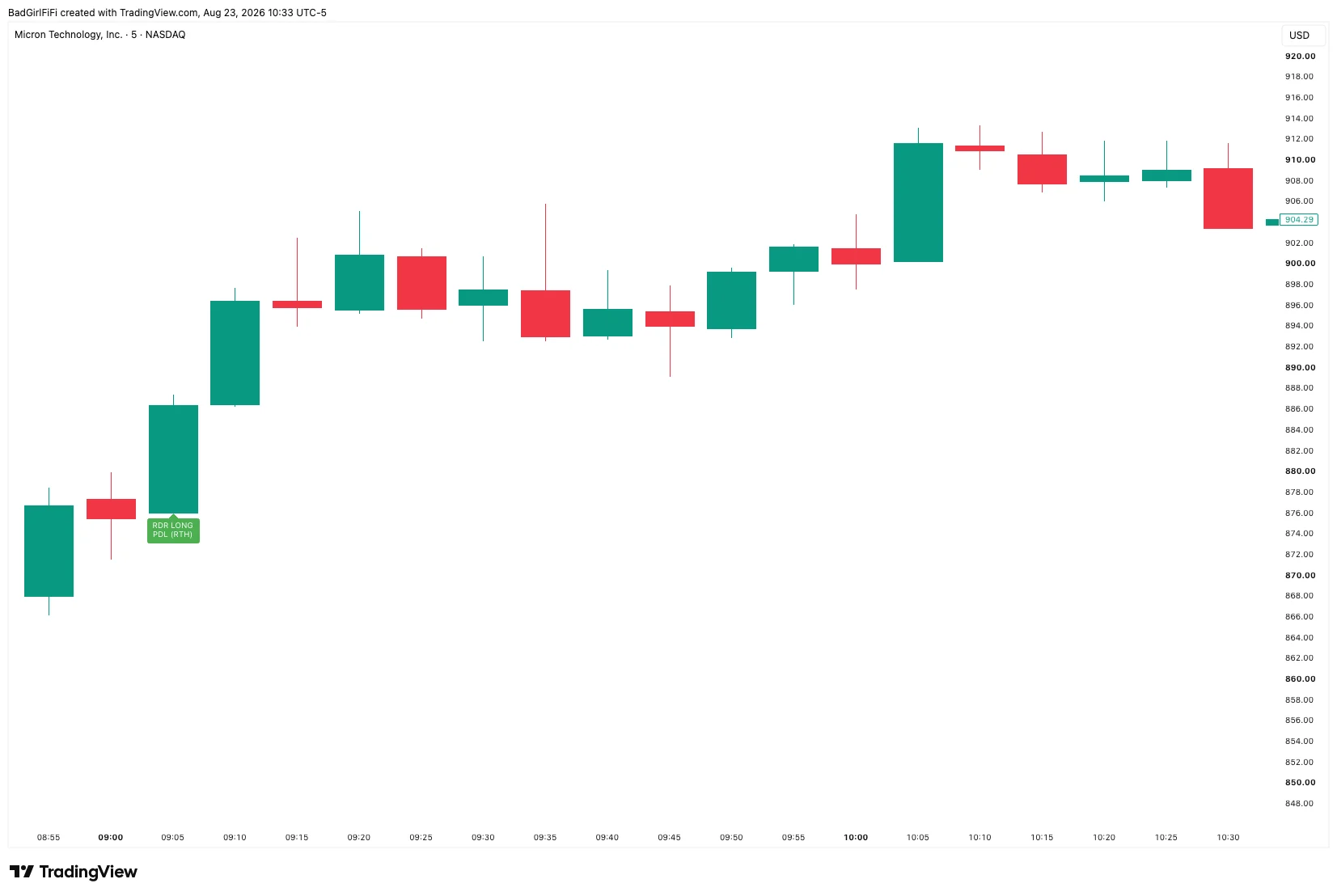
RDR LONG · PDL (RTH) — price undercut yesterday’s low, closed back above it, and ran roughly $30 over the next hour.
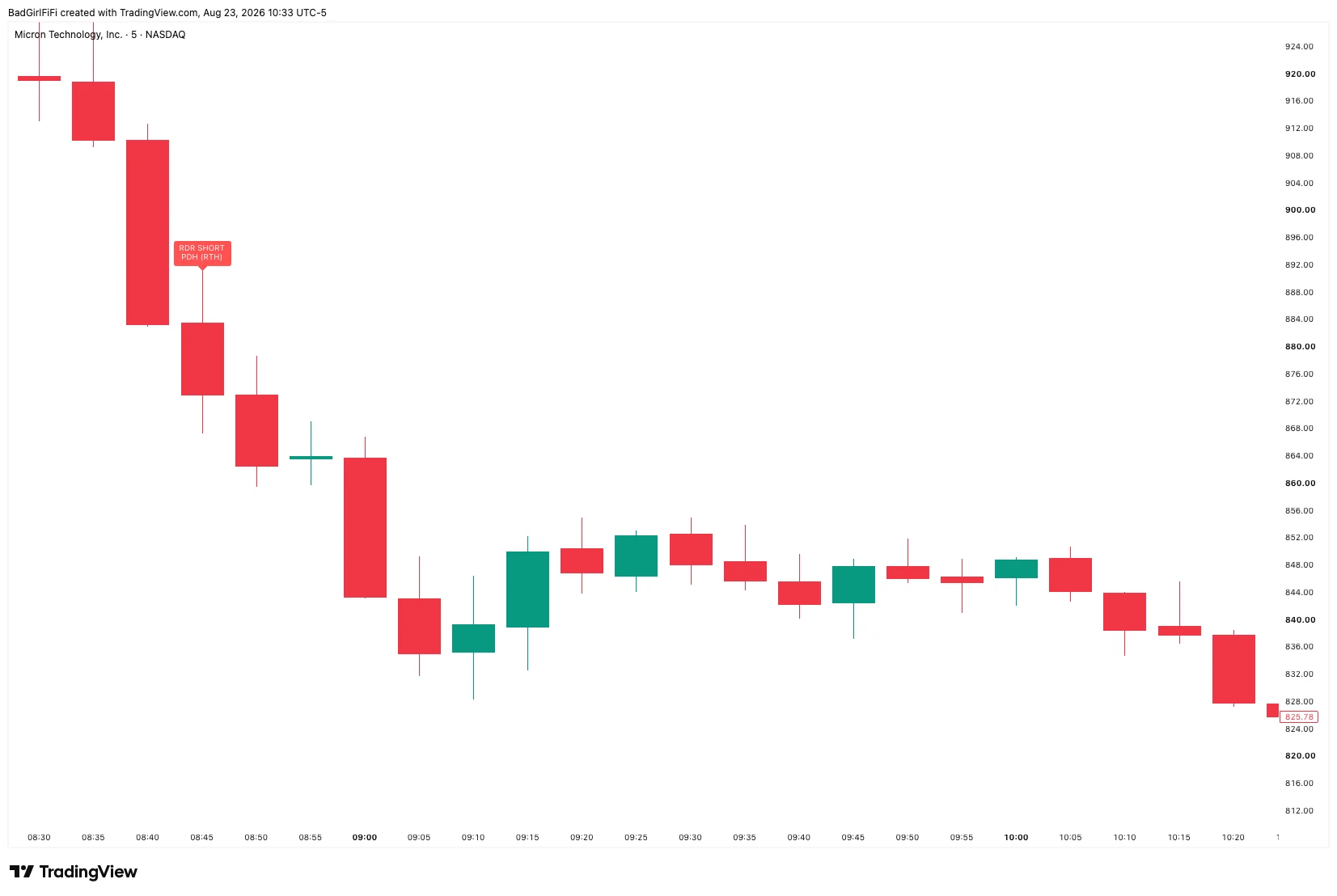 The mirror image.
 RDR SHORT · PDH (RTH) at the failed push through yesterday’s high, ahead of a sharp move down.
The label always names the level it fired against — PDH or PDL — so you know which side of yesterday’s range was defended.
Two ways to confirm
| Mode | What counts as a signal |
|---|---|
| Close Back Through Level (default) | The bar that closes back inside the range is the signal |
| Wick + Close Confirm Next Bar | The wick through is noted, and the following bar’s close confirms it |
The default is faster and gets you a better price. The alternative is slower and rejects more marginal breaks. Neither is wrong; the second suits people who have been burned by re-breaks.
Leave “Require prior close beyond level” on. With it on, a signal needs a bar that genuinely closed outside yesterday’s range before the reclaim. Off, a single wick through the level qualifies as the break — which produces far more signals and far more of them meaningless.
Oops — the failed gap
Same idea, moved to the open.
The market gaps beyond yesterday’s range — above the high or below the low — and then crosses back in. Everyone who chased the gap is now underwater, and the fill of that gap is the trade.
This one is time-boxed: it only counts inside the first stretch of the session, because a gap that reverses at 2pm isn’t the same event as one that reverses at 9:45. There’s a setting for how long that window is.
There’s a second path in. “Allow if gap not present but early cross occurs” lets the module fire when there was no gap but price crossed the level early anyway. It ships off, which makes Oops strictly a gap pattern by default. Turning it on widens it into a general early-session reversal — useful, but it stops being the pattern it’s named after.
Like RDR, it offers close-through or wick-plus-confirmation, and caps itself at one long and one short per day.
UNR — undercut and reclaim
The most selective of the three, and the one with the most information attached to it.
Two things have to fail at once. Price has to undercut a moving average and a pivot level, then reclaim both. Either one alone isn’t enough.
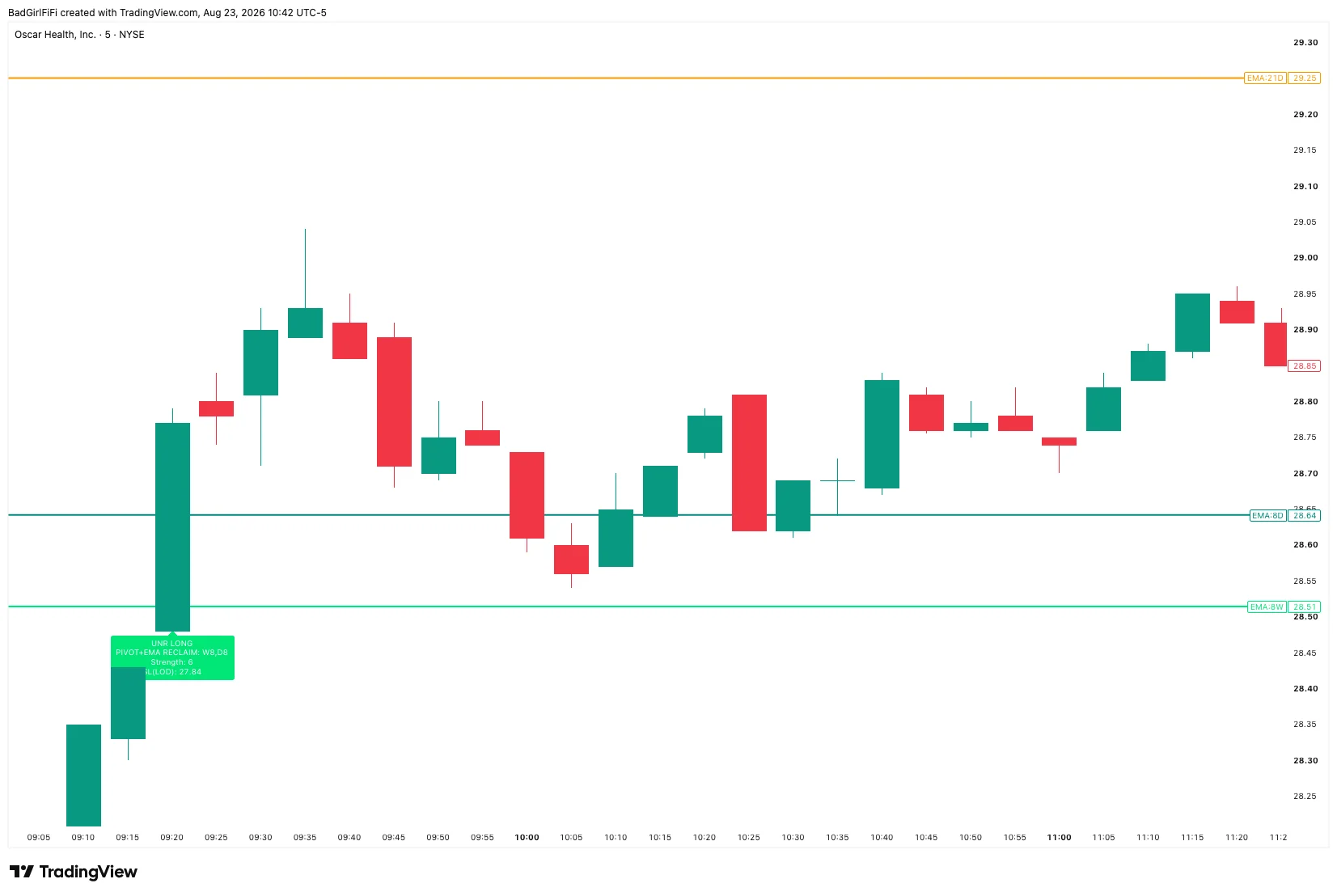
UNR LONG at 09:20, reclaiming the weekly and daily 8 EMAs together. Strength 6, suggested stop at the low of day.
Reading the label
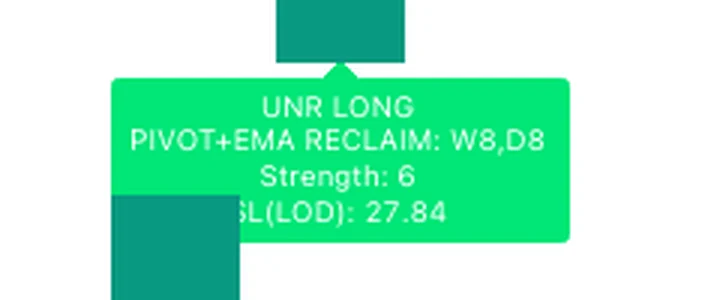
| Line | What it tells you |
|---|---|
| UNR LONG / SHORT | Direction |
| PIVOT+EMA RECLAIM (or FAIL for shorts) | What happened |
| W8, D8 | Which averages were involved — W = weekly, D = daily |
| Strength: 6 | How much confluence the reclaim had |
| SL(LOD): 27.84 | The suggested stop — low of day for longs, high of day for shorts |
Strength is the number to look at, and higher is better. It scores how much confluence the reclaim had — a low number is a technically valid signal at a single level; a high one is price recovering several timeframes’ worth of structure in one move. Treat the two as different trades, not the same trade with a different label.
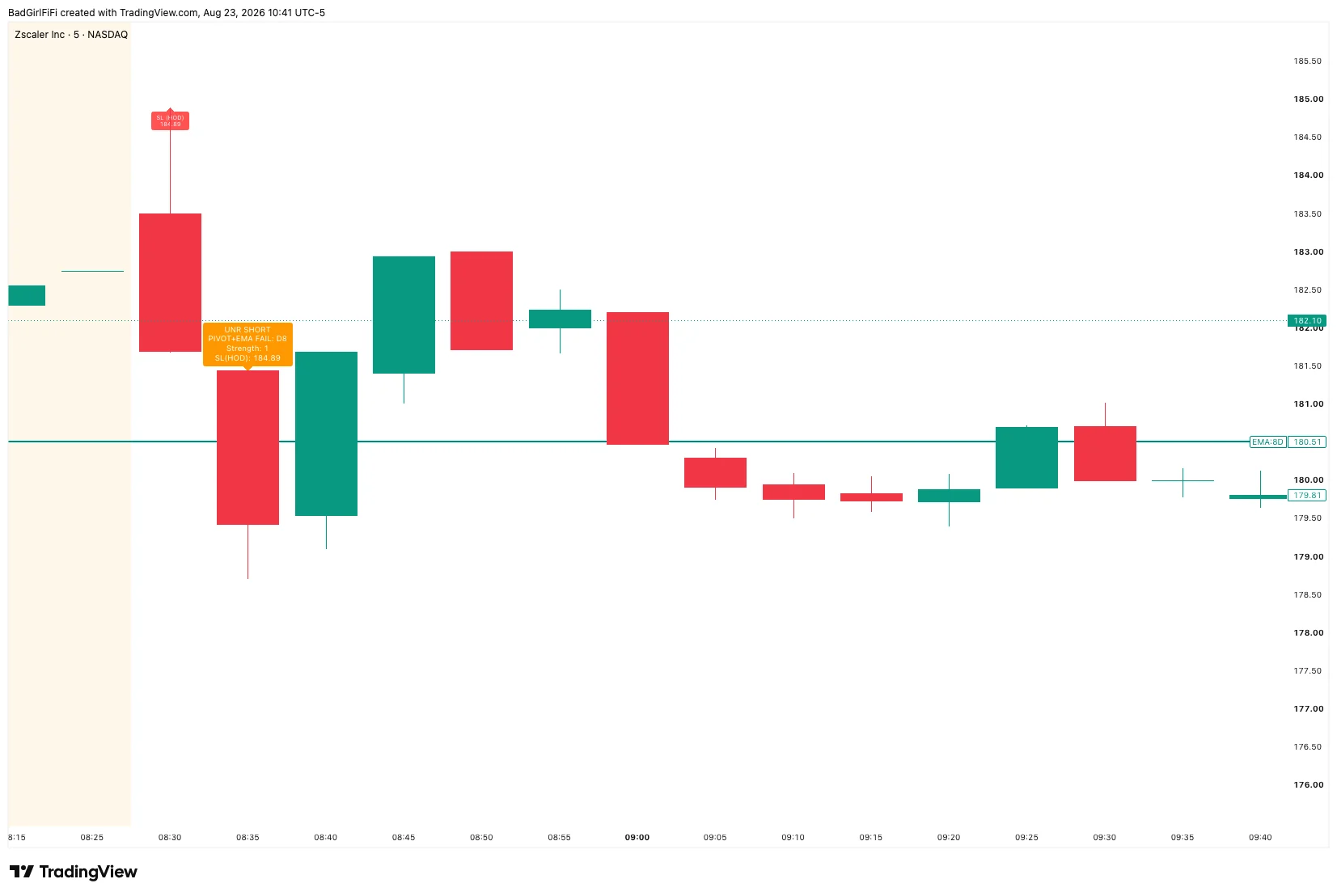
UNR SHORT · PIVOT+EMA FAIL: D8 · Strength: 1 — a single daily average, the weakest grade of signal. It worked here, but this is the tier where you want other reasons to be in.
The pivot rule is not what you’d expect
This catches people out, so read it twice.
For a long, the pivot being defended is yesterday’s high, not its low. The sequence is: price broke out above yesterday’s high, closed above it, then dipped back below — and reclaimed it. The old resistance is now being tested as support, and it held.
For a short, it’s yesterday’s low acting as failed support.
That’s the opposite of the “undercut a low” reading the name suggests, and it’s deliberate — it makes UNR a continuation-after-shakeout pattern rather than a bottom-fishing one. You’re joining an established move after it flushed the weak hands, not catching a falling knife.
There’s a tolerance setting in ATR if you want a small buffer around the pivot rather than an exact test. It ships at zero.
The EMA set
Daily 8, 21, 50, 100 and 200, plus weekly 8 and 21 — each one switchable.
The shipped default enables a mix of fast daily and weekly averages. The slower daily averages are available for people who trade off them, but including everything makes signals rarer and strength scores harder to compare against each other.
Selected averages plot on the chart with a tag on the right edge — EMA:8D, EMA:21D, EMA:8W — so you can see the level being tested before the signal fires.
Rules that apply to all three
Regular hours only, by default. Premarket produces constant false breaks of yesterday’s range on thin volume. The session window is adjustable if you want it.
One long and one short per module, per day. Without this a choppy name would tag the same level six times. With it, you get the first clean instance and nothing more — which is nearly always the one worth taking.
They can and do fire on the same name. RDR and UNR both key off yesterday’s high and low, so a single failed break can produce both. That’s confluence, not duplication.
The alerts go to Discord
Members get these in the channel as formatted cards.
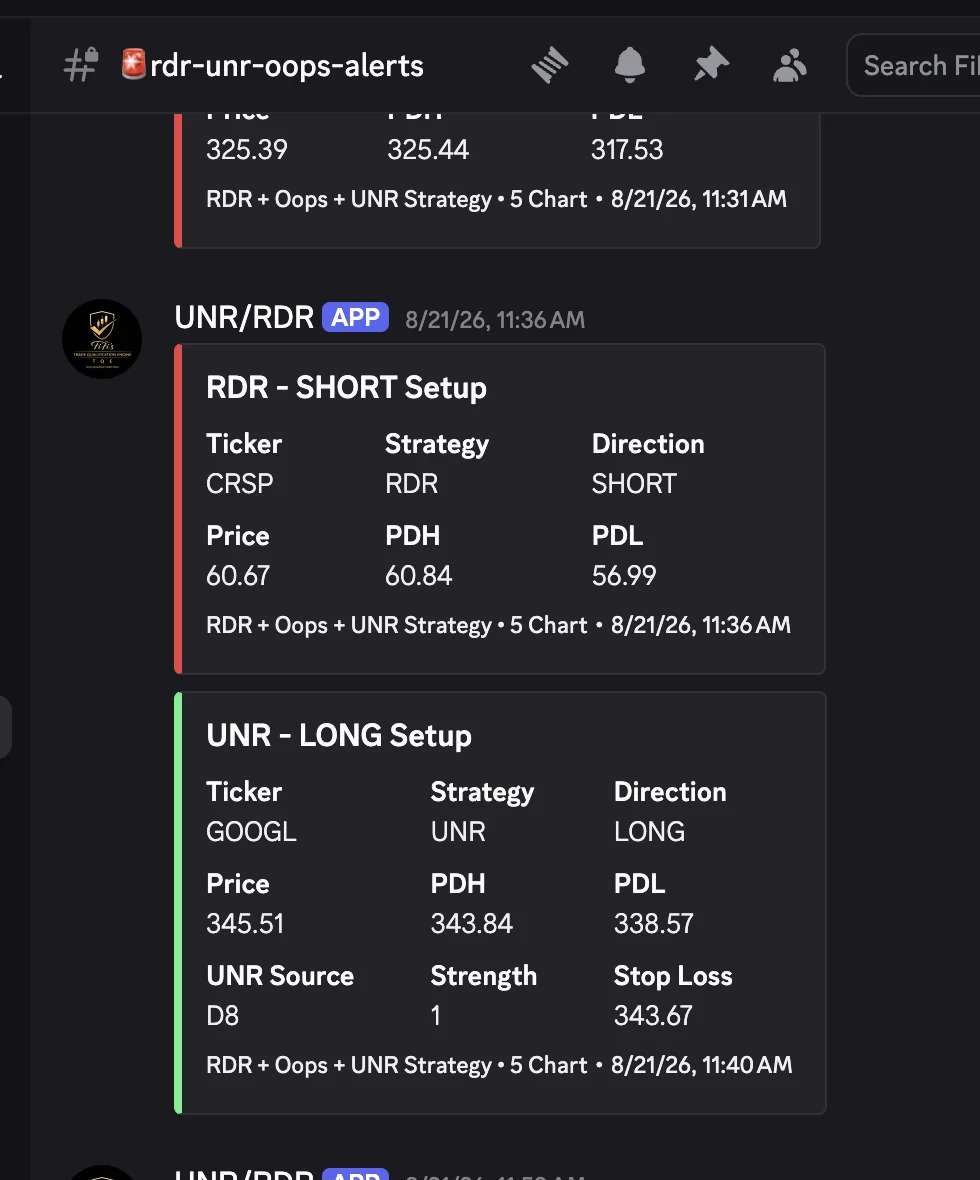 Each card names the module that fired, the direction, the price, and yesterday’s high and low. UNR cards add the average reclaimed, the strength score, and the stop.
Every card carries yesterday’s high and low alongside the price, which is the context you need to sanity-check the signal without opening a chart — you can see immediately how far into the range price has recovered.
Using it
This is a signal script, not a qualifier. It tells you a pattern completed. It does not tell you the setup is good — a failed break into a strong downtrend is still a failed break, and still a bad long. Pair it with trend context.
Strength is your filter on UNR. If you only take one thing from this page: a strength of 1 and a strength of 6 are not the same signal wearing the same label.
The stop is on the label for a reason. Every signal ships with an invalidation level attached. If the low of day is too far away to size sensibly, that’s the signal telling you to skip it rather than to widen your risk.
Combine with TQE Key Levels to see the levels being tested before anything fires, and with Trend Spine for the direction you should be favouring.
Settings
| Setting | Default | What it does |
|---|---|---|
| Only detect during RTH session | On | Ignores premarket breaks |
| RTH Session | 09:30–16:00 | The detection window |
| Enable RDR / Oops / UNR Signals | All on | Module switches |
| RDR Trigger Mode | Close Back Through Level | Or wick plus next-bar confirmation |
| RDR: Require prior close beyond level | On | Demands a real break before the reclaim — leave on |
| Oops: Require open gaps beyond PDH/PDL | On | Keeps Oops a gap pattern |
| Oops: Allow if gap not present but early cross | Off | Widens it to any early reversal |
| Oops: Must trigger within first N minutes | — | The early-session window |
| UNR Trigger Mode | Close Reclaim | Or wick plus next-bar confirmation |
| UNR: Require prior close on opposite side of EMA | On | Demands a genuine undercut first |
| UNR: Must trigger within first N minutes | — | How late in the session UNR can still fire |
| UNR: Enable Bearish mirror | On | Short-side signals |
| UNR: Require Pivot Undercut + Reclaim | On | The pivot half of the pattern |
| UNR: Pivot tolerance (ATR) | — | Buffer around the pivot level |
| UNR: Require prior close on ‘good’ side of Pivot | On | The breakout that preceded the shakeout |
| UNR EMA levels | — | Which daily and weekly averages count |
| Only 1 Bull and 1 Bear per day | On, all three | Per module |
FAQ
What do the acronyms mean?
RDR is a red dog reversal, Oops is an oops reversal, UNR is undercut and reclaim. Three well-known failed-breakout patterns, implemented against the same set of levels.
Why did UNR fire on a long when price was reclaiming yesterday's high?
That’s the design. For longs the pivot is yesterday’s high being retested as support after a breakout. See the pivot rule above.
What's a good strength score?
Higher is better and the scale is open-ended. 1 means one average was involved; the mid-single digits mean several, including slower ones. Treat low scores as needing outside confirmation.
Nothing has fired all day.
All three cap at one long and one short per module per day, all three require a genuine close beyond the level before the reclaim, and Oops and UNR both have time windows. On a quiet day that’s correct behaviour.
Can I run it on the daily?
No — the whole thing is built on intraday interaction with yesterday’s range. 1 to 15 minutes is where it works.
Which timeframe do the alerts run on?
The members’ feed runs on the 5-minute.
Walkthroughs
Where this fits
Every indicator in the engine is documented to the same standard.